Current ResearchPeer-ReviewedEvidence-Based

What the science says about
eating animals

A working shelf of current, peer-reviewed research on the psychology of meat — the meat paradox, masculinity, vegan identity, and compassion. These are the studies that shape how we think about widening the moral circle, and what actually moves behavior.

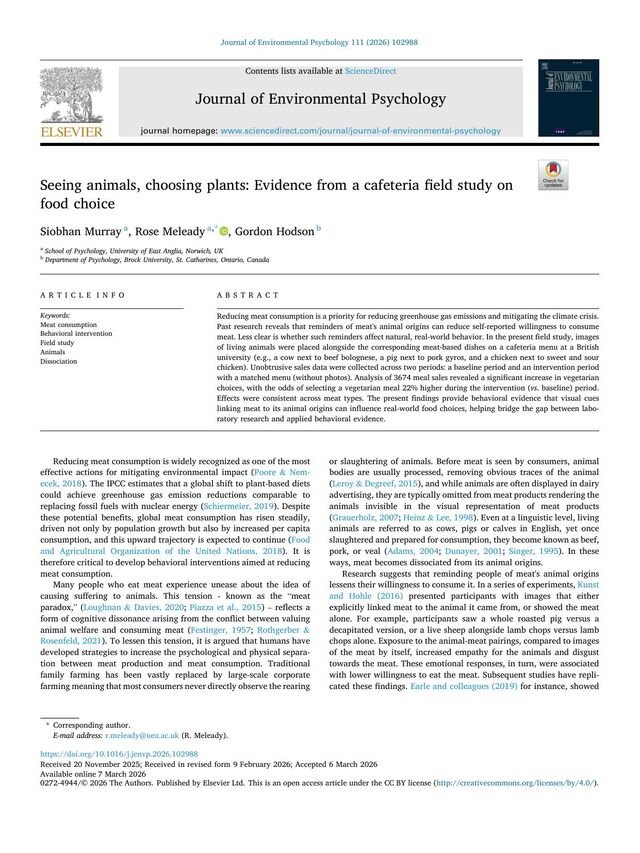
The cafeteria finding doesn't stand alone. It sits on top of a deep literature on why seeing the animal matters — and what stands between caring about animals and acting on it.

The meat paradox & seeing the animal

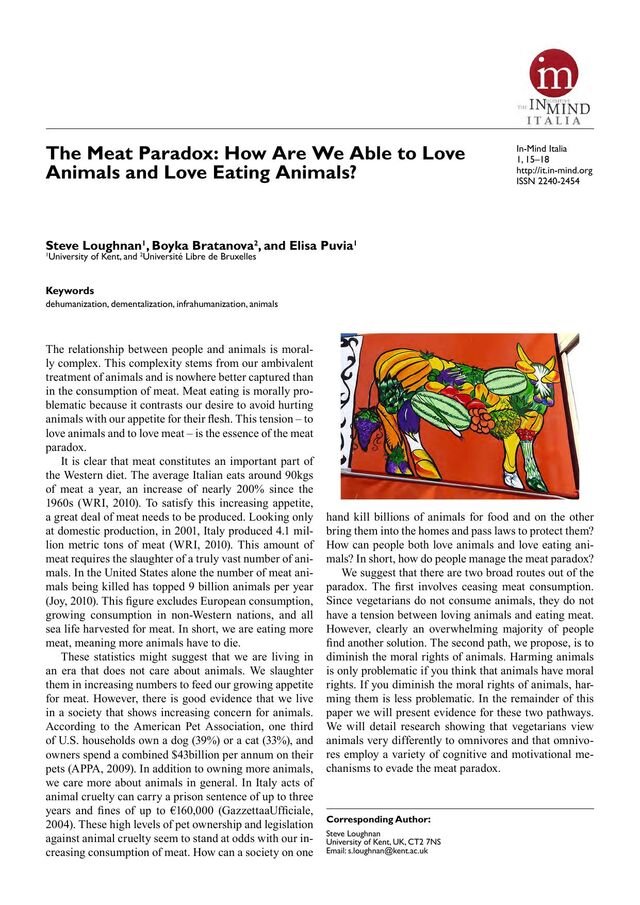
Title page of Loughnan, Bratanova, and Puvia (2012)

The meat paradox

The essay that named the tension: most people love animals yet eat them. Dissociating meat from its living source is what keeps that contradiction comfortable — which is exactly the gap the menu-photo study exploits.

Loughnan, S., Bratanova, B., & Puvia, E. (2012). The meat paradox: How are we able to love animals and love eating animals? In-Mind Italia, 1, 15–18.

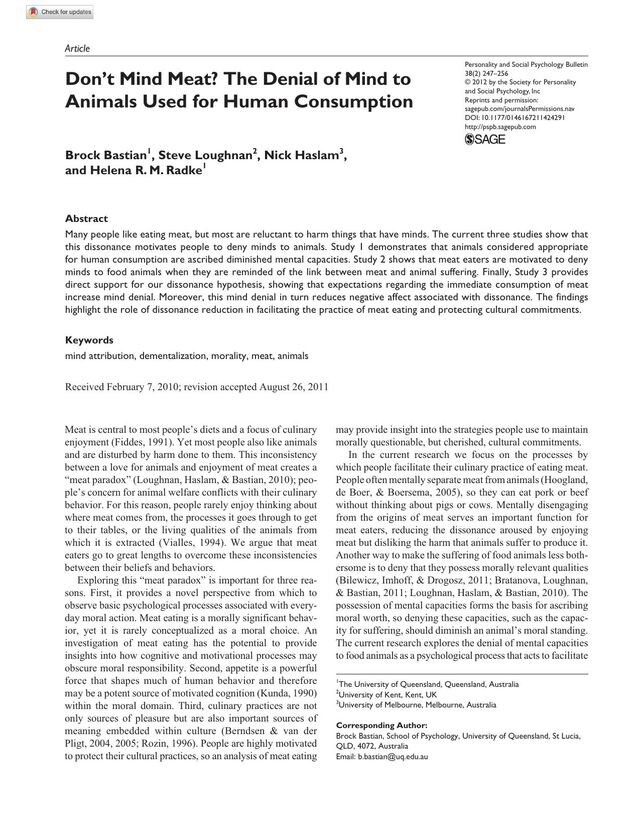
Title page of Bastian, Loughnan, Haslam, and Radke (2012)

Don't mind meat? Denying minds to food animals

The foundational experiments: simply categorizing an animal as "food" leads people to deny it a mind — and the less mind they grant it, the easier it is to eat. Moral disengagement, made measurable.

Bastian, B., Loughnan, S., Haslam, N., & Radke, H. R. M. (2012). Don't mind meat? The denial of mind to animals used for human consumption. Personality and Social Psychology Bulletin, 38(2), 247–256. https://doi.org/10.1177/0146167211424291

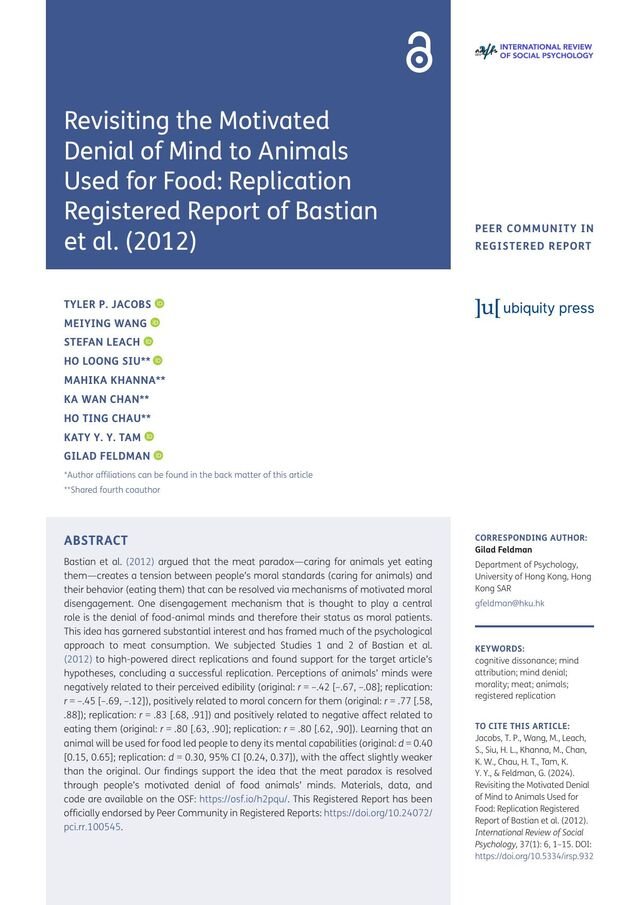
Title page of Jacobs et al. (2024)

Does it replicate? Yes.

A high-powered, pre-registered replication of Bastian et al. (2012) reproduces the effects cleanly — reassurance that mind-denial is a robust route to resolving the meat paradox, not a one-lab fluke.

Jacobs, T. P., Wang, M., Leach, S., Siu, H. L., Khanna, M., Chan, K. W., Chau, H. T., Tam, K. Y. Y., & Feldman, G. (2024). Revisiting the motivated denial of mind to animals used for food: Replication registered report of Bastian et al. (2012). International Review of Social Psychology, 37(1), Article 6, 1–15. https://doi.org/10.5334/irsp.932

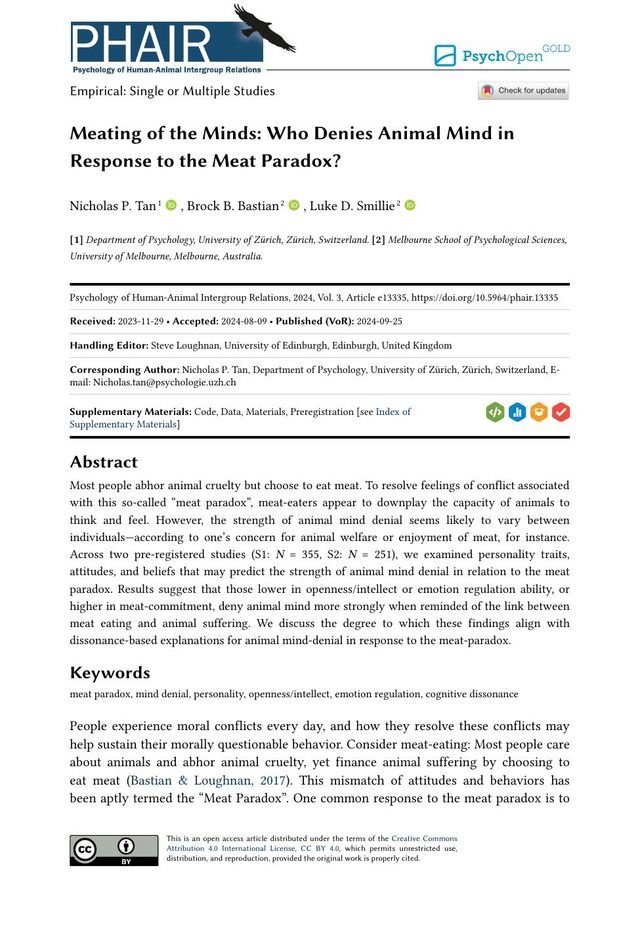
Title page of Tan, Bastian, and Smillie (2024)

Who denies animal minds most?

Not everyone disengages equally. People lower in openness or emotion regulation — and higher in commitment to eating meat — deny animal minds most strongly when reminded of the link between meat and suffering.

Tan, N. P., Bastian, B. B., & Smillie, L. D. (2024). Meating of the minds: Who denies animal mind in response to the meat paradox? Psychology of Human-Animal Intergroup Relations, 3, Article e13335. https://doi.org/10.5964/phair.13335

Masculinity & meat

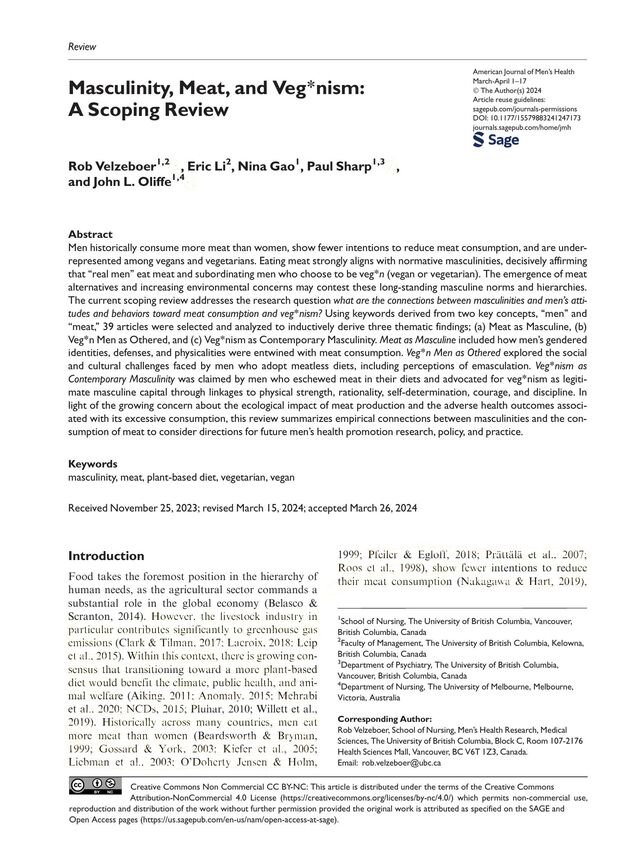
Title page of Velzeboer et al. (2024)

Masculinity, meat, and veg*nism: a scoping review

A map of how "real men eat meat" norms subordinate vegan and vegetarian men — and where, under environmental pressure and shifting ideals, those norms are beginning to bend.

Velzeboer, R., Li, E., Gao, N., Sharp, P., & Oliffe, J. L. (2024). Masculinity, meat, and veg*nism: A scoping review. American Journal of Men's Health, 18(2), 1–17. https://doi.org/10.1177/15579883241247173

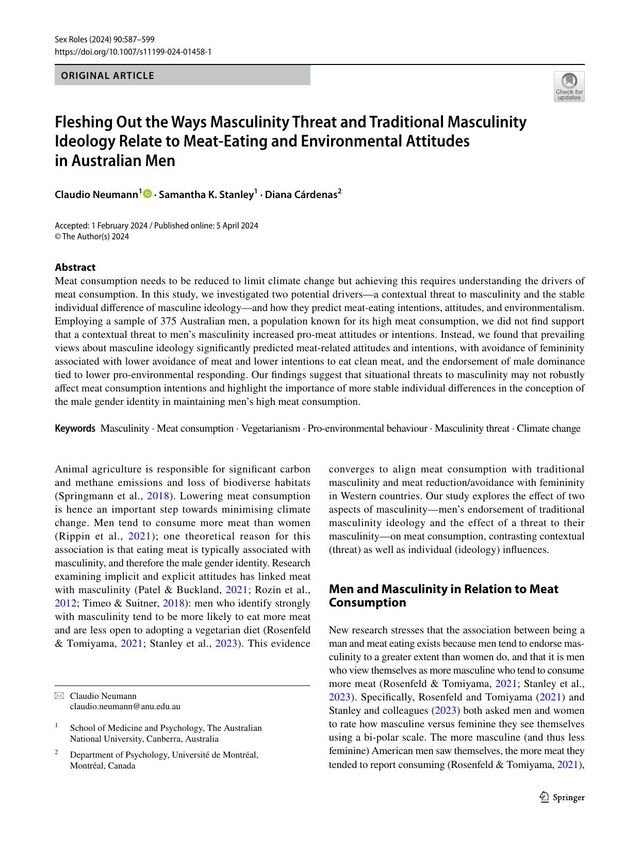
Title page of Neumann, Stanley, and Cárdenas (2024)

Masculinity threat vs. masculine ideology

Tested against 375 Australian men: stable traditional-masculinity ideology tracks meat-eating attitudes and weaker environmentalism more reliably than a momentary "threat" to manhood does.

Neumann, C., Stanley, S. K., & Cárdenas, D. (2024). Fleshing out the ways masculinity threat and traditional masculinity ideology relate to meat-eating and environmental attitudes in Australian men. Sex Roles, 90, 587–599. https://doi.org/10.1007/s11199-024-01458-1

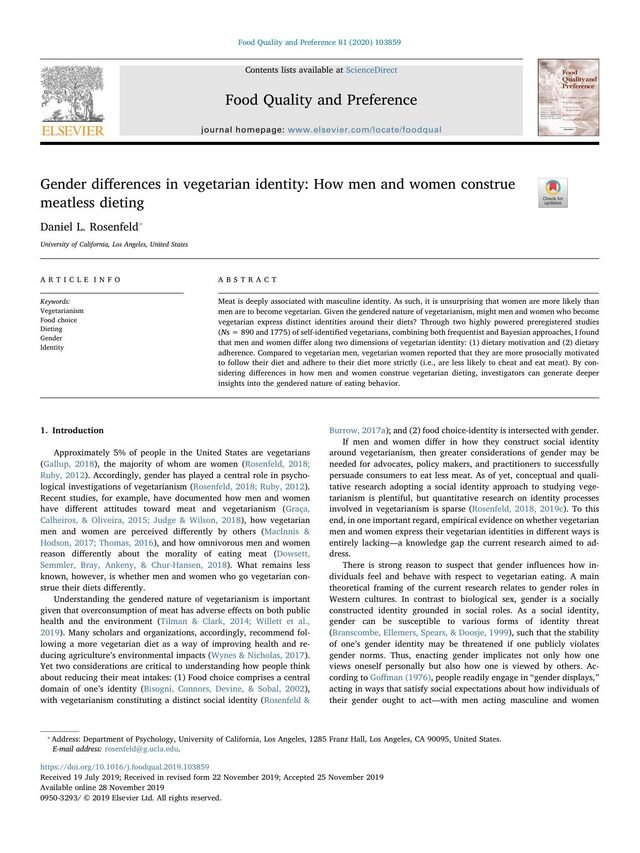
Title page of Rosenfeld (2020)

How men and women construe meatless dieting

Gendered identity, not just taste, shapes who becomes vegetarian: men and women build their meatless eating around different self-concepts, with implications for how outreach is framed.

Rosenfeld, D. L. (2020). Gender differences in vegetarian identity: How men and women construe meatless dieting. Food Quality and Preference, 81, Article 103859. https://doi.org/10.1016/j.foodqual.2019.103859

Vegans as a social group

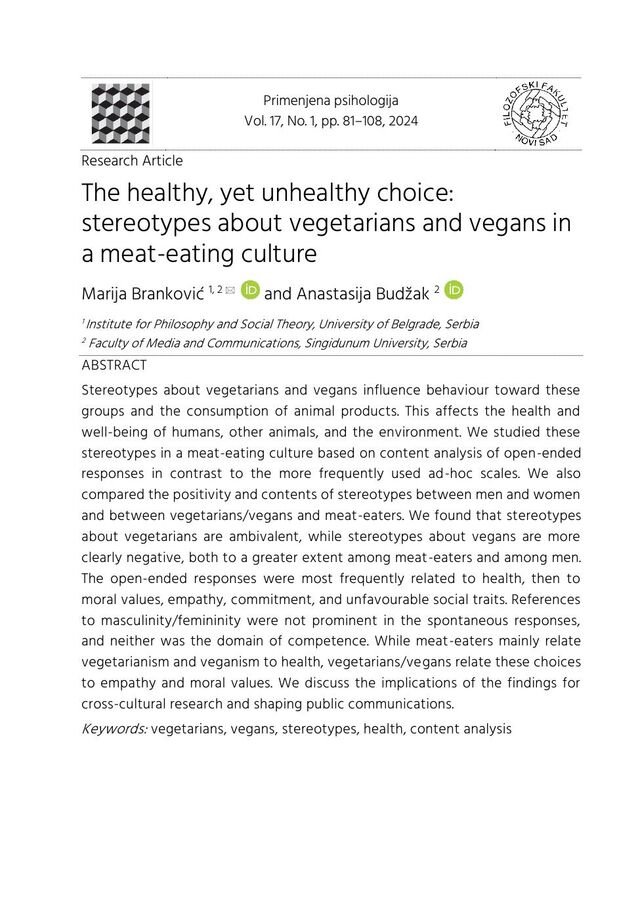
Title page of Branković and Budžak (2024)

The healthy, yet unhealthy choice

Vegetarians and vegans get stereotyped two ways at once — admired for discipline, penalized as the odd, "unhealthy" other — revealing the social friction that meat-eating cultures impose on those who opt out.

Branković, M., & Budžak, A. (2024). The healthy, yet unhealthy choice: Stereotypes about vegetarians and vegans in a meat-eating culture. Primenjena Psihologija, 17(1), 81–108. https://doi.org/10.19090/pp.v17i1.2479

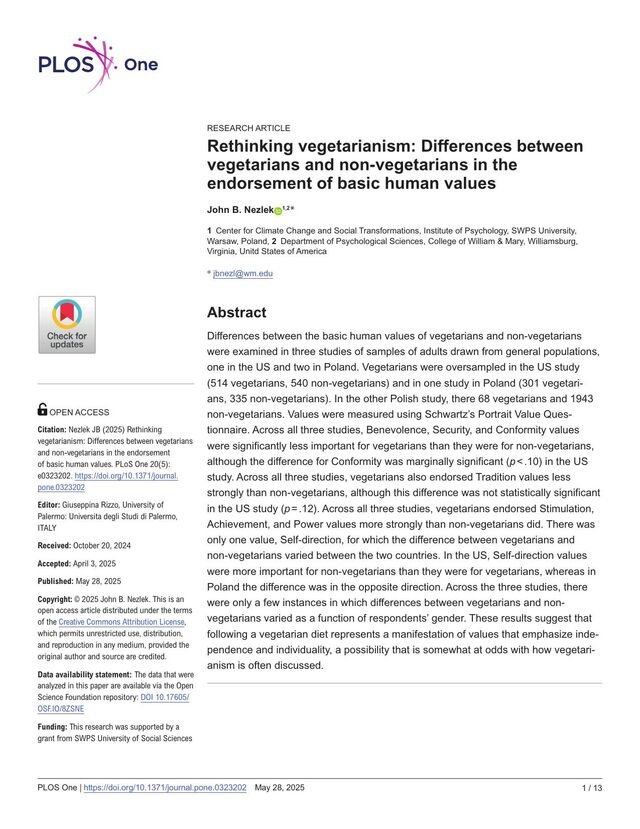
Title page of Nezlek (2025)

Vegetarianism as a value system

Vegetarians endorse a distinct profile of basic human values — more universalism, less power and achievement — suggesting diet is downstream of a broader moral orientation, not just a food preference.

Nezlek, J. B. (2025). Rethinking vegetarianism: Differences between vegetarians and non-vegetarians in the endorsement of basic human values. PLOS ONE, 20(5), Article e0323202. https://doi.org/10.1371/journal.pone.0323202

Compassion — toward others and ourselves

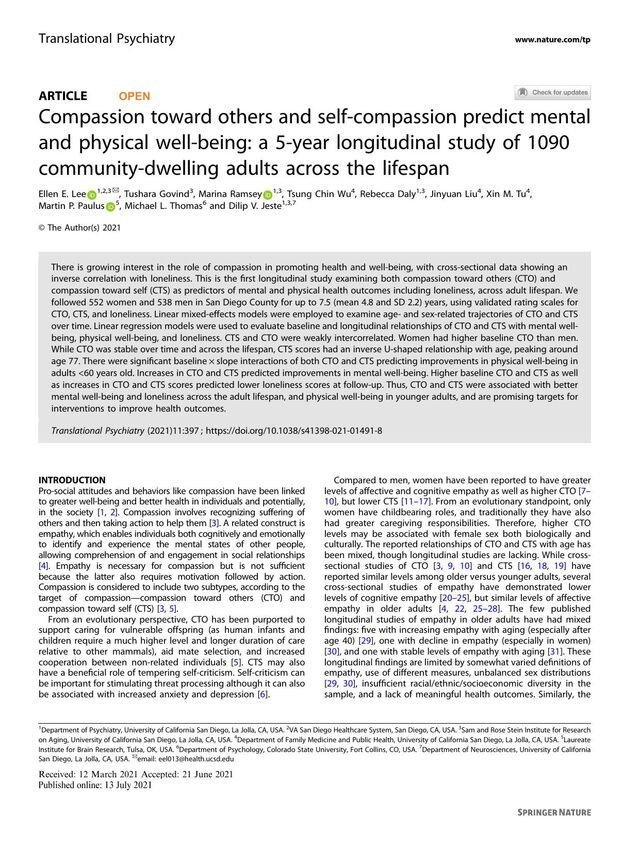
Title page of Lee et al. (2021)

Compassion is protective — for five years running

In 1,090 adults followed over five years, both compassion for others and self-compassion predicted better mental and physical well-being. Widening the circle of care, it turns out, is good for the one doing the caring too.

Lee, E. E., Govind, T., Ramsey, M., Wu, T. C., Daly, R., Liu, J., Tu, X. M., Paulus, M. P., Thomas, M. L., & Jeste, D. V. (2021). Compassion toward others and self-compassion predict mental and physical well-being: A 5-year longitudinal study of 1090 community-dwelling adults across the lifespan. Translational Psychiatry, 11, Article 397. https://doi.org/10.1038/s41398-021-01491-8

Three threads, one circle

Read together, these studies trace a single arc: how kindness toward oneself, kindness toward other people, and kindness toward animals are bound up with one another — and how cultural scripts about masculinity and meat keep that circle artificially small. That intersection is the heart of the research program behind this project.

Animal Compassion NYC is a project of psychologist Michael Magee, PhD, whose lab studies self-compassion, vegans as a social group, and compassion for non-human animals — including the first empirical tests linking self-compassion to animal-compassion.

Title-page images are reproduced at thumbnail resolution to identify each source for scholarly and educational reference; copyright remains with the respective publishers. Follow each DOI link for the full article.